EB-5 Visa Statistics by Country: Where U.S. Green Cards Are Going
May 31, 2024 · EB-5 · 10 min read
More than one-quarter of all EB-5 visas issued in the first two quarters of fiscal year 2024 went to applicants from Vietnam, a country that is not oversubscribed in the EB-5 category. For families pursuing a U.S. green card through EB-5, the figures show how per-country visa allocation works in practice.
More than one-quarter of all EB-5 visas issued in the first two quarters of fiscal year 2024 went to applicants from Vietnam. Figures for visas issued are published by the U.S. Department of State, which allocates immigrant visa numbers and issues the visas; U.S. Citizenship and Immigration Services (USCIS) adjudicates the EB-5 petition that comes first. For anyone weighing a U.S. green card through EB-5, the numbers continue to point in an encouraging direction, and they are particularly striking for investors from Vietnam.
“Positive signals” may be the phrase most often used to describe the EB-5 Immigrant Investor Program in recent months. As of the date of this article, May 31, 2024, adjudication capacity at USCIS continues to improve, processing times are shorter, more petitions are being approved and, notably, the number of EB-5 visas issued to investors from Vietnam keeps rising.

More EB-5 visas available in 2024
Under the per-country limits in the Immigration and Nationality Act, each country is normally held to about 700 EB-5 visas a year — 7% of the 10,000 visas allocated worldwide. That level is a reference point rather than a hard ceiling: under INA §202(a)(5), where the visas available in an employment-based category exceed the qualified applicants who could otherwise use them, those visas are issued without regard to the per-country limit, in priority-date order. For fiscal year 2024, the number available to each country rose to nearly double that figure, about 1,561 visas, split into 569 reserved visas — for rural projects, high-unemployment area projects and infrastructure projects — and 992 unreserved visas available to every type of project.
Two factors explain this. First, a large number of family-sponsored visa numbers left unused in 2023 were added to the employment-based limit for the following year under the Immigration and Nationality Act, which raised the numbers available in the EB-5 category. Second, reserved EB-5 visas left unused in 2022 and 2023 were accumulated and carried over into 2024 under the new rules of the EB-5 Reform and Integrity Act of 2022, enacted in March 2022.
What the numbers show for Vietnam
The U.S. fiscal year 2024 ran from October 1, 2023, to September 30, 2024. The article attributes its figures to U.S. Citizenship and Immigration Services (USCIS); visa issuance itself is reported by the U.S. Department of State. On those figures, EB-5 visas issued to investors from Vietnam had already reached 1,326 by the end of March 2024, all of them drawn from the unreserved allocation. That is 26% of all EB-5 visas issued worldwide. Only half the year had passed, yet issuance had already gone beyond the 992 unreserved visas nominally available to a single country — which the per-country rules permit, since visas that would otherwise go unused continue to be issued in priority-date order. Further EB-5 visas were issued to investors from Vietnam in April and May.
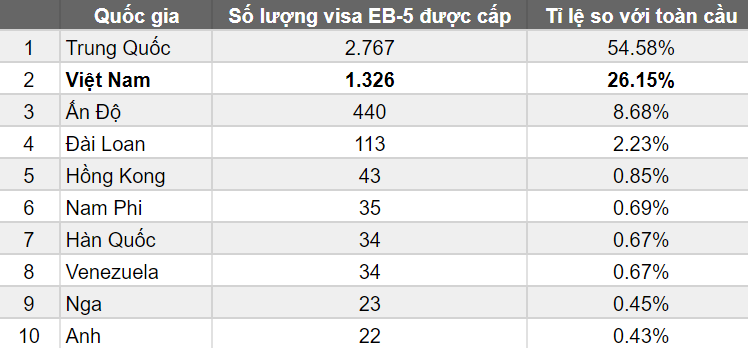
EB-5 visas issued by country in the first two quarters of fiscal year 2024, from October 1, 2023, to March 31, 2024 (Source: IIUSA)
Normally, EB-5 visa numbers left unused in a given year by countries with low EB-5 volumes are reallocated to countries that are oversubscribed, such as China. That is why investors from China consistently take the largest share of EB-5 visas, above the per-country limit — which the Immigration and Nationality Act permits when visa numbers in the category would otherwise go unused. Many practitioners believe the same mechanism is now working in Vietnam’s favor: visas issued in the first two quarters of fiscal year 2024 alone ran past the per-country level and came close to the combined total for 2022 and 2023.
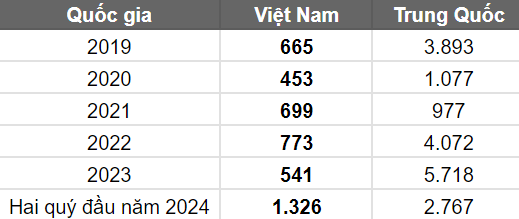
EB-5 visas issued to investors from Vietnam and China by year (Source: IIUSA)
Vietnam is not an oversubscribed country, and on that basis it accounted for 26% of all EB-5 visas issued — second to China and ahead of third-placed India, which is oversubscribed and had received 440 visas, or 8.68%.
Read together, the figures point to something more specific than preferential treatment. Because Vietnam is not oversubscribed in the EB-5 category, U.S. immigrant visas in EB-5 have been available to applicants from Vietnam as their priority dates are reached, rather than after a wait behind a per-country queue. Visa numbers are allocated and the visas issued by the U.S. Department of State under the Immigration and Nationality Act, and published each month in its Visa Bulletin, while USCIS adjudicates the Form I-526E petition that comes first; neither agency gives priority by nationality.
Two EB-5 projects in focus
1. Whisky Hotel: construction more than 90% complete

Whisky Hotel is a small upscale hotel of 7 floors and 132 rooms on the Hollywood Walk of Fame in California. USCIS has approved the project’s Form I-956F application, the project filing required for an EB-5 offering. An I-956F approval is a decision on that filing, not an endorsement of the investment by USCIS or any other U.S. government agency, and each investor’s Form I-526E petition is still adjudicated on its own record.
As of the date of this article, construction is more than 90% complete. On that progress, the jobs created already exceed the minimum of 200 qualifying jobs needed for the 20 investors participating in the project — 10 full-time positions for qualifying employees per investor, the requirement each investor must meet on Form I-829, Petition by Investor to Remove Conditions on Permanent Resident Status, the step that turns a conditional green card into an unconditional one. Each petition is decided on its own record.
With construction more than 90% complete, the sponsor reports that the project’s current value also exceeds its combined bank and EB-5 debt. Its location near the venues for the 2026 FIFA World Cup and the 2028 Olympic Games supports the business case the sponsor has set out, and leaves more than one route — a refinancing or a sale — to repayment of EB-5 capital at maturity. As with any EB-5 investment, repayment is not guaranteed.
2. Thunder Ridge: a rural project from long-established regional center EB5 Capital

Thunder Ridge is an expansion and upgrade of the 20,000-seat Thunder Ridge – Nature’s Arena entertainment and amphitheater complex. It sits within the well-known Big Cedar Lodge resort destination in Ridgedale, Missouri, which covers 1,860 hectares (about 4,600 acres) and draws around 7.5 million visits a year, and is known for its strikingly unspoiled natural setting, 5 championship golf courses that host a U.S. professional tournament, and a wide range of attractions and activities.
As of the date of this article, the project is in its final stages, with opening set for June 13, 2024 and a series of major events already booked. The EB-5 capital is managed by EB5 Capital, a long-established regional center.
The project also sits in a rural area, which under the EB-5 Reform and Integrity Act of 2022 means priority processing of the Form I-526E petition and access to the set-aside, or reserved, EB-5 visa allocation.
See details of the EB-5 projects we work with for a U.S. green card.
If you are considering a U.S. green card through the EB-5 Immigrant Investor Program, speak with an advisor at IMM Group or leave your details below. Our experienced advisory team will walk you through the requirements in detail and help support a well-prepared application. We are committed to keeping your personal data confidential and will use the information you provide only to advise on your family’s case.
IMM Group
Was this article helpful?