Singapore GIP Application Process: A Step-by-Step Guide from Submission to Permanent Residence
December 4, 2025 · Singapore · 15 min read
Singapore is a leading financial and technology hub in the Asia-Pacific region, known for its transparent, secure business environment, modern infrastructure, and well-developed education and healthcare systems. It also maintains tight immigration controls and does not offer citizenship by investment.
Through the Global Investor Programme (GIP), Singapore offers a legitimate pathway for international entrepreneurs and investors to apply for Singapore permanent residence (PR) through genuine, substantial investment. Below, we walk through the Singapore GIP application process step by step.

Singapore GIP Application Process: A Step-by-Step Guide from Submission to Permanent Residence
Overview of the Global Investor Programme (GIP)
The GIP is designed to attract successful entrepreneurs and investors with substantial financial capacity and a long-term commitment to investing in Singapore.
GIP investment options (2025)
- Option A: Invest at least S$10 million to establish or expand a company operating in Singapore.
- Option B: Invest S$25 million in an EDB-approved GIP-select fund focused on businesses in Singapore.
- Option C: Establish a Singapore-based single family office with at least S$200 million in assets under management, subject to additional requirements on staffing, reporting, and investment in Singapore.
Beyond the investment amount, applicants must demonstrate business capability, a transparent financial history, and a concrete plan for their activities in Singapore.
Average Singapore GIP timeline: from application to PR
The table below summarizes the main stages of the GIP review process:
Step
What happens
Estimated time
1
Preparing and submitting the application
1–2 months
2
EDB assessment and interview
3–6 months
3
Approval-in-Principle (AIP) letter issued
Months 6–9
4
Investment made under the AIP
Within 6 months of the AIP
5
Investment verification and grant of PR
1–2 months
Average total time: 6–12 months, depending on the strength of the application and how quickly the investment is completed.
Documents required for a GIP application
1. Personal documents
- Valid passport.
- Marriage certificate (if a spouse is included).
- Children’s birth certificates (if dependent children are included).
- Police clearance certificate (if required).
- Proof of current residence.
- Documents not in English must be translated into English and notarized.
2. Business documents
- Audited financial statements for the last 3 years.
- Business license and proof of shareholding.
- The company must have annual revenue of at least S$200 million, and the applicant must hold at least 30% of the shares (under the Established Business Owner profile).
3. Investment plan
- A description of the proposed business in Singapore: industry, financial model, and hiring strategy.
- Projected number of employees to be hired in Singapore.
- Revenue and profit projections for the next 3–5 years.
The role of the Economic Development Board (EDB)
The EDB:
- Assesses GIP applications, including the applicant’s entrepreneurial track record and investment plan.
- Interviews applicants to assess the substance of their plans and their level of commitment.
- Issues the AIP letter if the criteria are met.
- Verifies that the investment has been completed before recommending that the Immigration & Checkpoints Authority (ICA) grant PR.
The EDB also connects applicants with Singapore’s business ecosystem, helping them find strategic partners, investment funds, or legal advisors.
Key milestones on the path to Singapore PR through the GIP
- Submit the GIP application: through the EDB’s online application system, with all supporting documents and the application fee.
- Assessment and interview: if the application passes initial screening, the EDB may invite the applicant to an interview.
- Approval-in-Principle (AIP): if approved, the applicant has 6 months to complete the investment.
- Investment verification: submit financial records, contracts, and proof of investment to the EDB.
- PR granted: after verification, the ICA grants PR to the applicant and eligible dependents.
Common mistakes and how to avoid them
Common mistake
Cause
How to address it
The business does not meet the financial criteria
Insufficient revenue, unaudited financial statements
Review financial statements early and work with an internationally recognized audit firm
Vague investment plan
No concrete business model
Write a detailed business plan with financial and market forecasts
Failing to complete the investment within the AIP period
Insufficient legal and financial preparation
Start preparing the investment in parallel with the assessment
Mistaking PR for citizenship
Limited legal understanding
Be clear that PR is long-term residence, not citizenship
Losing PR by letting the Re-entry Permit (REP) lapse
Not tracking document expiry dates
Set reminders to renew the REP on time
Common misconceptions about Singapore PR through the GIP (and the facts)
Although Singapore does not actively market residency by investment, the GIP still draws interest from many investors across Asia. Lacking reliable official information, however, some approach the program with unrealistic expectations. Below are 4 common misconceptions, each with a reality check based on current policy.
“Having enough money is all it takes to get Singapore PR”
The reality: The GIP is not a “buy residency” program. Beyond the minimum investment of S$10–25 million, the EDB closely assesses company revenue, financial statements, management experience, and the ability to create economic value in Singapore. Applications without sufficient substance will be rejected, however large the investment.
“PR automatically leads to Singapore citizenship”
The reality: PR is long-term residence status only. Citizenship requires a separate application, with a period of actual residence in Singapore (typically 2–6 years), stable income, social integration, and renunciation of your current citizenship, as Singapore does not permit dual citizenship.
“With PR, you can come and go from Singapore at any time”
The reality: PR remains valid while you are abroad only if you hold a valid Re-entry Permit (REP). The REP is typically valid for 5 years. If you leave Singapore after your REP has expired, you will lose your PR status permanently and must reapply from the start, with a very low chance of approval. It is a small administrative oversight with serious consequences.
“The GIP accepts any type of investment”
The reality: The EDB considers only investment plans aligned with Singapore’s sustainable development priorities and strategic sectors. Encouraged sectors include:
- High technology (deep tech, AI, robotics)
- Healthcare and medical services
- Fintech (financial technology)
- Renewable energy and green manufacturing
- Logistics and high-value supply chains
By contrast, passive investment models with no clear economic impact and no plan to hire local staff are typically rejected outright.
The GIP is a transparent, selective residency pathway suited to entrepreneurs with a solid track record and a commitment to contributing to Singapore’s economy. To succeed, however, applicants need a well-prepared financial file, a practical investment strategy, and a clear understanding of the obligations that come with Singapore PR.
IMM Group: why choose a proven advisory firm?
The global investment migration market is constantly shifting and increasingly complex, so investors need an advisory partner who can not only help build a strong application but also serve as a trusted anchor for the family’s future. That is why, across all investment migration solutions, IMM Group offers a distinct advantage as a strategic advisory partner, standing alongside you with experience and integrity.
As a pioneer with more than 21 years of hands-on experience in Vietnam, IMM Group does not act as a sales agent. We do more than advise — we design investment migration solutions built on:
- Rigorous due diligence and risk management: Having successfully handled hundreds of applications, including complex cases, we conduct multi-layered project due diligence and protect investors’ interests rigorously, including during periods of market stress.
- In-depth professional advice and full transparency: Every IMM Group consultant and case manager holds an international investment migration advisory certification issued by the Investment Migration Council (IMC). Our team provides a comprehensive analysis of benefits and risks so you can make decisions based on complete and accurate information. We put our clients’ long-term interests first.
- Integrity and commitment at every stage: Guided by our philosophy, “Serving with Authentic Values,” IMM Group commits to supporting you from the first step until your family is settled. Integrity is our foundation, reflected in our readiness to protect client interests and to proactively refund fees when objective risks beyond the client’s control arise (as set out in the service agreement).
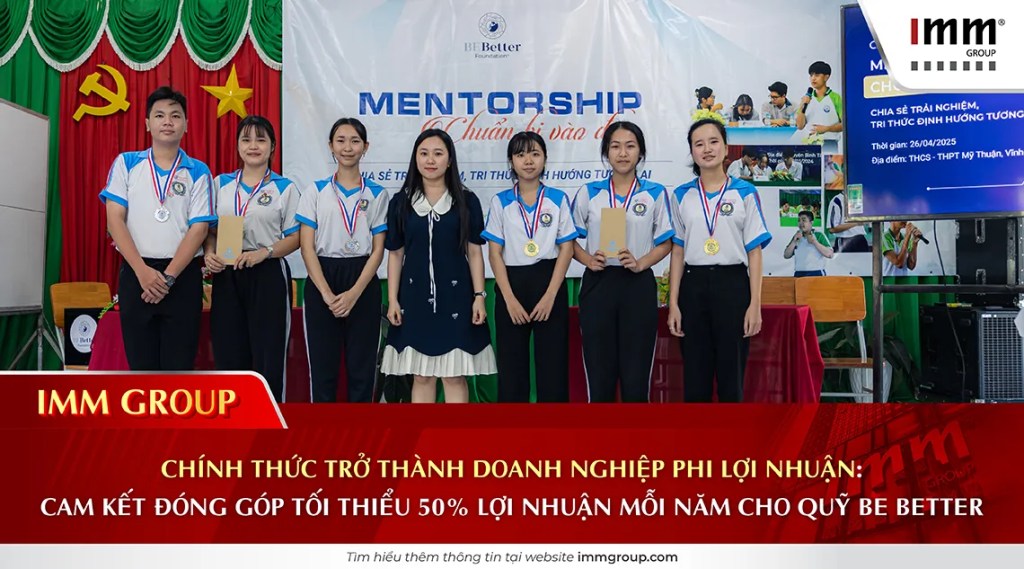
- Giving back: Since 2025, IMM Group has operated as a nonprofit enterprise, committing at least 50% of its annual profits to the Be Better Fund. By choosing IMM Group, you join us in supporting meaningful initiatives and the social responsibility and human values we pursue.
If you are interested in global investment and citizenship programs, you can contact IMM Group or leave your details below. Our experienced advisors will provide detailed guidance and help assess the prospects of your application. We are committed to keeping your personal data confidential and will use the information you provide solely to advise on your family’s application.
IMM Group