


Green card benefits
- Freedom to enter and leave the United States, and to live and move anywhere in the country.
- Children attend public school free of charge through high school and can apply to leading U.S. universities on the same footing as domestic students, including access to the support available to them. Tuition for permanent residents is typically about 3 times lower than the international-student rate.
- The freedom to work for any employer, with no restriction on the type of work or the hours, and no sponsor required.
- The ability to apply for the licenses needed to establish and run a business in the United States.
- The ability to petition for your spouse and unmarried children under 21 to join you in the United States.
- Eligibility to apply for U.S. citizenship 5 years after your green card is issued. Families who prefer to remain U.S. permanent residents may instead keep that status indefinitely.
The purpose of the EB-5 program: creating jobs for U.S. workers
In 1990, Congress created theU.S. investor immigration program, EB-5. Under it, an investor, together with a spouse and unmarried children under 21, may obtain a U.S. EB-5 green card and permanent residence by investing the required capital in a U.S. business and creating at least 10 jobs for U.S. workers. This route is known as direct, or stand-alone, EB-5 investment.
In 1992, the EB-5 program was broadened with the introduction of the regional center route. Under this model, a number of investors pool the required capital in a project that an EB-5 regional center sponsors and manages. The requirement remains at least 10 jobs for each investor. Job creation is measured using reasonable economic methodologies and may count direct, indirect, and induced jobs. If a restaurant opens near a project to feed the construction crew, for example, the positions at that restaurant can also count. This method of measuring job creation works in the EB-5 investor’s favor.
The EB-5 regional center route did not end after the 5 years originally envisaged for the pilot. Following a series of extensions, it was incorporated into the EB-5 Reform and Integrity Act of 2022 (RIA), enacted on March 15, 2022. Under the RIA, the EB-5 regional center program is authorized through September 30, 2027.
How much does the EB-5 program require you to invest?
The EB-5 Reform and Integrity Act of 2022 (RIA) raised the standard minimum EB-5 investment from US$1,000,000 to US$1,050,000 effective March 15, 2022. The U.S. government also set a reduced threshold of US$800,000 to encourage investment in projects located in a Targeted Employment Area (TEA) or in infrastructure projects. A TEA is either a rural area or an area of high unemployment.
- A rural area is defined as an area that is neither within, nor adjacent to, a metropolitan statistical area or a city or town with a population of 20,000 or more.
- A high-unemployment area is an area with an unemployment rate at least 150% of the national average.
Both thresholds, US$1,050,000 and US$800,000, are scheduled to be adjusted upward from January 1, 2027, and every 5 years thereafter, with the increase tied to inflation over the intervening period.
Estimated costs
The total budget for an EB-5 application comprises the statutory minimum investment plus professional and administrative fees:
- The qualifying investment: A minimum of US$800,000 into a project that meets the program’s requirements.
- Government filing fees, administrative fees, legal fees, and advisory fees: these are non-refundable and cover adjudication by U.S. government agencies, the regional center’s fee for administering the investment over several years, counsel to advise on and prepare the petition, and advisory support from the firm assisting with the file. These amounts vary from case to case. For example, engaging experienced, well-regarded counsel to strengthen a petition costs more, but it helps protect the investor against problems later on.Taken together, these fees typically come to approximately US$116,000.
In total, an EB-5 investor should budget approximately US$887,000. The US$800,000 invested in the EB-5 project is intended to be repaid once the investor has completed the green card process, the required jobs have been created, and the investment term agreed with the project has run (typically around 4–5 years) — although, as with any at-risk investment, repayment is not assured. On that basis, the non-recoverable cost of pursuing a U.S. green card is in the region of US$116,000, set against benefits that extend to your spouse, your children, and future generations.
Why most EB-5 investors choose the regional center route
Because of these advantages, investment through a regional center now accounts for more than 95% of EB-5 petitions, and it is widely regarded as the investment U.S. immigration most established and safest route.
Regional centers are companies and organizations designated by U.S. Citizenship and Immigration Services (USCIS) to raise and administer EB-5 investor capital on behalf of a project. Most EB-5 regional center projects qualify as TEAs, which means the applicable investment threshold is US$800,000.
An investor who takes the direct EB-5 route must run the business themselves in order to satisfy the EB-5 program’s requirements. Beyond the investment itself, the project carries annual operating costs, and the risk profile is considerably higher than that of a regional center investment.
Through an EB-5 regional center, the investor’s commitment is the US$800,000 subscription. Administering the capital and meeting the program’s requirements are the regional center’s responsibility. Established regional centers retain in-house analysts and attorneys who carry out detailed due diligence, with the aim of confirming that a project is soundly structured and that its job-creation projections and EB-5 capital ratio are credible
The EB-5 Reform and Integrity Act strengthens oversight of regional centers
A regional center operates in much the same way as a lending institution: it pools investor capital and lends it to an EB-5 project for an agreed term. Developers are often drawn to EB-5 capital because it prices below bank and other credit-institution debt. Stronger sponsors will typically secure the EB-5 loan with substantive collateral.
Under the EB-5 Reform and Integrity Act, federal oversight of EB-5 regional centers has increased substantially since 2022, which has brought greater transparency and more disciplined investor protections to the program.
In particular, USCIS now conducts periodic audits of regional centers, examining how EB-5 capital has been deployed and how the project is progressing. A regional center must also file all project documentation with USCIS before it accepts investor capital.
The EB-5 Reform and Integrity Act likewise imposes a more rigorous process on regional centers, which are required to conduct thorough due diligence to establish that a project’s developer has both the financial capacity and the professional expertise to deliver it.
How long does it take to receive an EB-5 visa?
EB-5 adjudication runs in two stages: Form I-526 (before you move to the United States) and Form I-829 (after you move to the United States).
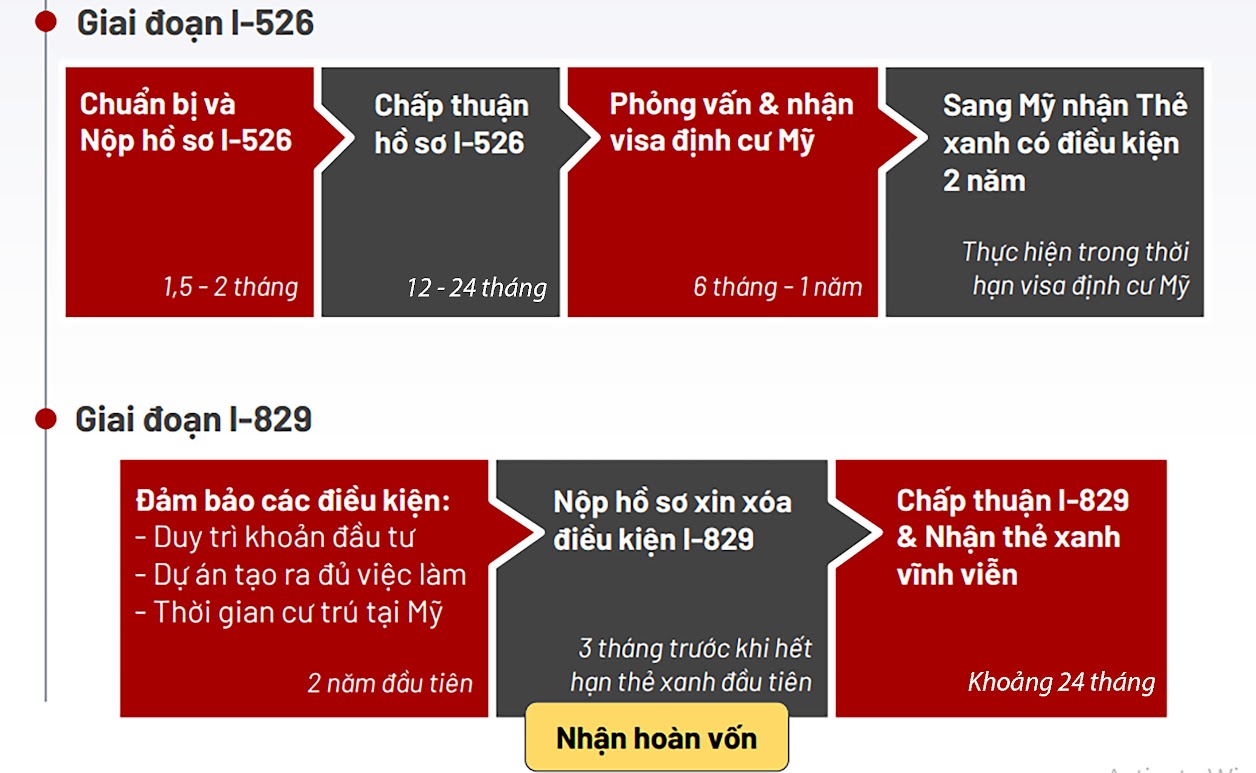
From the start of preparing the Form I-526 filing to receiving the visa EB-5 and moving to the United States takes roughly 3–3.5 years on average. The actual wait, however, depends on whether your country’s annual visa allocation is still available at the time your Form I-526 is approved.
At the start of each fiscal year, the U.S. government makes approximately 10,000 new visas available to the EB-5 category. No single country of chargeability may take more than 7.1% of that total, or roughly 700 visas a year. If the year’s allocation is already exhausted when your Form I-526 is approved, you wait for a later year, in order of filing priority. This affects the leading source countries for EB-5, such as China, India, and Vietnam.
To check where your country stands, follow the Visa Bulletin published monthly by the Bureau of Consular Affairs of the U.S. Department of State. The July 2023 Visa Bulletin shown below is an illustration. Vietnam sits in the “All Chargeability Areas Except Those Listed” group with an EB-5 final action status of C (Current), meaning visa numbers are available and there is no wait. China, by contrast, was then current only for petitions with a priority date before January 1, 2016, and India for petitions before December 8, 2019.

Since July 2022, Vietnam has had no EB-5 visa backlog. That window will not stay open indefinitely: whenever EB-5 demand from Vietnam exceeds the per-country allocation, the wait returns.
My child is 19 or 20. Is there still time to file so the whole family can move together?
The EB-5 program allows dependent children who are under 21 and unmarried. Adjudication before the family moves to the United States can take 3–3.5 years where there is no visa wait, so many investors with children aged 19–20 assume the window has closed. In practice, when visa numbers are favorable, a family can still file even with a child who is 20.
The reason is the Child Status Protection Act (CSPA). Under the CSPA, a child’s age is effectively “locked” at the time the Form I-526 is filed. While the Form I-526 is pending — currently around 27 months — that period does not count against the child’s age. The pending time is deducted only once the Form I-526 is approved. If visa numbers remain available, the wait for the EB-5 visa interview averages about 6 months. With prompt document preparation and an experienced advisory team at the filing stage, a child in this age range need not age out of the family’s case.
The EB-5 adjudication process has seen substantial improvement over the past 2 years. Continuing that reform, USCIS published its Fiscal Year 2023–2026 Strategic Plan earlier in the year, calling for faster case processing and for the United States to be a welcoming nation for immigrants.
Vietnam currently has no EB-5 visa backlog and USCIS is pressing ahead with processing reform. For families with a child approaching 21, this is a favorable moment to pursue U.S. residence through EB-5.
Since 2022, rural EB-5 projects have carried a distinct advantage
Under the EB-5 Reform and Integrity Act of 2022 (RIA), EB-5 visas are reserved for 3 set-aside project categories. Rural projects receive 20% of the annual visas, projects in high-unemployment areas 10%, and qualifying infrastructure projects 2%.
These set-asides apply only to petitions filed on or after March 15, 2022, so visa numbers are currently available in all 3 categories for every country of chargeability. Set-aside visas not used within a fiscal year carry over to the same category the following fiscal year; if they are still unused at the end of that year, they are released to other employment-based categories.
The U.S. government is plainly encouraging investment in rural projects. With 20% of visas reserved for them, EB-5 petitions tied to rural projects move through a more favorable queue. Should demand exceed the allocation, approved rural EB-5 petitions can be adjudicated ahead of others under the rule that prioritizes petitions with visa numbers available.
Processing times for rural projects should therefore shorten further. Alongside projects in high-unemployment areas, regional centers are expanding their rural EB-5 pipelines to capture this visa and adjudication advantage.
Is EB-5 capital guaranteed to be returned?
Congress created the EB-5 immigrant investor program so the U.S. economy would benefit from investors’ capital. The statute requires that capital be placed at risk and create at least 10 jobs. A written commitment guaranteeing the return of an investor’s capital would mean there is no risk at all — it would breach EB-5 requirements, and the petition would be denied.
Investing through an established EB-5 regional center does not remove that risk, but it does improve the prospects for repayment, which typically occurs after a minimum of 5 years. A strong regional center brings professional capability to project due diligence, capital structuring, and oversight of EB-5 funds. The developer, in turn, must evidence the project’s business performance and can put payment guarantees or other credit support behind the EB-5 loan.
Long-established regional centers such as CanAm, EB5 Capital… report having repaid EB-5 capital in full on every project for which they have raised EB-5 funds to date; past performance is not an indication of future results. Across 15 years advising on EB-5, IMM Group has supported hundreds of investors in obtaining U.S. green cards, and many of those families have since had their capital repaid in full or are approaching the repayment stage.
How should you evaluate a regional center?
A regional center worth entrusting with an EB-5 investment should be assessed against the following factors:
- Experience and a reputation built over many years.
- The number of its projects approved by U.S. Citizenship and Immigration Services (USCIS) and the number of green cards issued to its investors.
- Total capital raised and total capital repaid to EB-5 investors.
- The quality of the projects it has financed in the past.
CanAm is one example of a long-established regional center. Its reported milestones include:
- More than 6,500 immigrant investors from 88 countries.
- More than US$3.1 billion raised across 65 EB-5 projects.
- US$2.27 billion of EB-5 capital repaid to EB-5 investors across 51 projects.
- More than 5,200 Form I-526 and I-526E petitions approved, and more than 15,400 conditional green cards issued.
- More than 2,600 Form I-829 petitions approved, and more than 8,400 investors moving on to green cards without conditions.
How should you evaluate an EB-5 project?
When choosing an EB-5 project for your investment, two sets of questions matter most:
- Supporting the green card outcome
- The project must qualify as a Targeted Employment Area (TEA).
- How many jobs it is projected to create, which economic model produces that figure, and whether it sits comfortably above the program requirement.
- The regional center’s record of administering and monitoring the use of EB-5 capital on earlier projects.
- The track record of the developer’s and the regional center’s previous EB-5 projects.
- Supporting the prospects for repayment
- The sector the project operates in, and whether the business case is sound and feasible.
- Whether the project has raised the full capital needed to reach completion, and how heavily it depends on EB-5 funding.
- A developer reputation established over many years.
- The project’s capital structure.
- Whether the repayment plan for EB-5 investors is realistic, and whether the EB-5 capital is secured by collateral.
- The terms on which capital is returned to you if the Form I-526E petition is denied through a fault on the project side.
How do I document my source of funds?
To guard against money laundering, every residency-by-investment program requires investors to document a lawful source of funds. For the EB-5 program, that source of funds standard is among the most demanding.
An EB-5 petition must therefore carry complete documentation of the activities that generated the income behind the investment. Every step needs to be done correctly from the outset. Where filings contain misrepresentation or implausible claims, the petition is not only denied — the investor may be permanently barred from filing in the future.
At the preparation and filing stage, your advisory firm matters a great deal. An experienced, attentive adviser will help you assemble the strongest petition the facts allow.
As one of the first firms to bring the EB-5 program to Vietnam, IMM Group supported its first successful EB-5 petition in 2008, among the earliest advisers to bring the program to its market. Alongside a deeply experienced in-house team, the firm works with Morrie Berez, formerly of the EB-5 adjudications unit at USCIS, as its exclusive adviser. Over 16 years, we have assessed every case individually to confirm that a client meets the program requirements before any formal engagement is signed.
If you are interested in theU.S. EB-5 investor immigration program, contact IMM Group or leave your details below. Our advisers will walk you through the detail and help assess how your case is likely to be received. We keep your personal data confidential and use what you provide solely to advise on your family’s case.
IMM Group


