USCIS: EB-5 Filings Rose in FY2023 as the I-526 Approval Rate Improved Significantly
January 15, 2024 · EB-5 · 10 min read
Total I-526 petitions filed in fiscal year 2023 reached their highest level in three years, and the I-526 approval rate improved significantly. EB-5 remains a U.S. residency-by-investment program chosen by many investors around the world.
According to USCIS statistics, in the final quarter of fiscal year 2023 (July 1 to September 30, 2023), new I-526 filings continued to rise, reaching their highest level in 14 quarters (since Q2 FY2020). As a result, total I-526 petitions filed in FY2023 also reached a three-year high. EB-5 remains a U.S. residency-by-investment program chosen by many investors around the world.
Obtaining a U.S. green card through EB-5 is now a familiar concept to many investors. It is a U.S. immigrant investor program that leads directly to a green card — conditional for the first two years — with clear requirements and a defined pathway, and many families around the world have pursued it successfully. The EB-5 process involves two key USCIS petitions: I-526 (including Form I-526E, filed by regional center investors since the 2022 reform) and I-829. Filing volumes and approval rates are figures investors follow closely. According to the latest USCIS data for Q4 FY2023 and for fiscal year 2023 as a whole, new EB-5 filings rose sharply, while the average denial rate, although lower than in FY2022, remained relatively high.

EB-5 statistics FY2023: a look back at the key filing figures
In Q4 FY2023, USCIS received 945 new I-526 petitions, up sharply from 699 in Q3 and 535 in Q2. Regional center investments continued to dominate, accounting for nearly 94% of all filings. USCIS adjudicated 1,354 I-526 petitions in Q4, the highest number since Q2 FY2020, bringing total I-526 adjudications for FY2023 to 3,626 — a marked increase from just 1,415 in FY2022.

I-526 petition data by quarter (Source: USCIS and IMI Daily)
Although the I-526 denial rate edged up to 35% in Q4 from the previous quarter, the average denial rate for FY2023 as a whole fell sharply to 40%, down from 58% in FY2022. Industry experts suggest that the high I-526 denial rates of recent years may stem from the surge of filings in 2018–2019 — large volumes submitted at once, many of them weaker cases — ahead of the official increase in the program’s minimum investment amount. The denial rate may continue to fall as USCIS completes adjudication of the remaining petitions from that period.
In FY2023, a total of 2,735 investors worldwide filed I-526 petitions, roughly three times the 829 and 814 recorded in FY2022 and FY2021, respectively. USCIS data also show that the average I-526 processing time for investors who filed before the EB-5 Reform and Integrity Act of 2022 (RIA) exceeded 50 months, while 63 investors who filed after the Act were approved within two years.
The steady shortening of processing times, together with the growing number of adjudications in recent periods, reflects USCIS’s efforts to deliver on its commitment to increase processing capacity and streamline its adjudication system. However, with new filings rising sharply again, EB-5 investors are advised to file early, before case backlogs return and the annual visa allocation is once again used up.
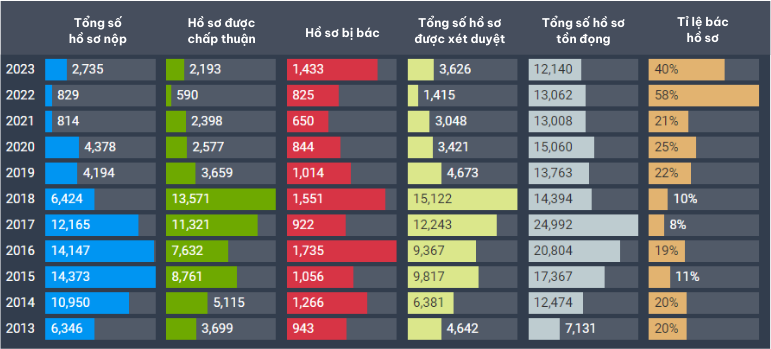
I-526 petition data by year (Source: USCIS and IMI Daily)
For Form I-829 — the petition to remove the conditions on the two-year green card and become a permanent resident without conditions — new filings changed little year over year: 1,157 in FY2023 versus 1,270 in FY2022. The I-829 denial rate also rose only modestly, from 10.36% in FY2022 to 12.76% in FY2023. I-829 adjudications followed the same upward trend as I-526, reaching 2,045 in FY2023.
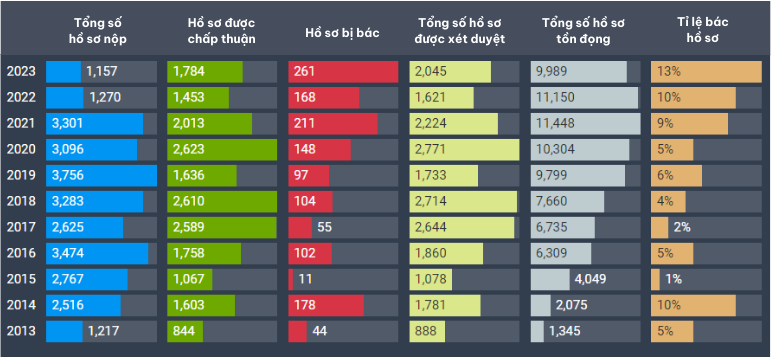
I-829 petition data by year (Source: USCIS and IMI Daily)
EB-5 remains a suitable route to a U.S. green card for investors in 2024
EB-5 is the only U.S. immigrant visa category based on investment, with a clear pathway that leads directly to a green card (conditional for the first two years) without first holding a temporary visa. By investing US$800,000 through a regional center in a project located in a targeted employment area (TEA) or in an infrastructure project, and creating at least 10 full-time jobs for qualifying employees, the investor, their spouse, and their unmarried children under 21 may obtain a U.S. green card.
Once they hold green cards, the whole family can live, study, work, and do business freely in the United States and enjoy most of the rights and benefits of U.S. citizens, the right to vote being the main exception. Children can attend public school free of charge through high school, and at public universities they may qualify for in-state tuition once they meet the state’s residency requirements — often around one-third of the rate charged to international students — as well as for federal student aid.

EB-5 has attracted, and continues to attract, thousands of investors from around the world. With advantages such as no degree, English-language, or business-experience requirements, together with positive signals about USCIS’s commitment to expanding adjudication capacity, 2024 is seen as a favorable year for investors planning to file for EB-5. Alongside these advantages, however, USCIS review is becoming increasingly stringent. To improve the chances of approval, investors should prepare complete documentation and set out a clear, persuasive case strategy that fully meets the program’s requirements.
If you are considering a U.S. green card through the EB-5 immigrant investor program, contact IMM Group or leave your details below. Our experienced advisors will provide detailed guidance and help assess the prospects of your case. We will keep your personal data confidential and use the information you provide only to advise on your family’s case.
IMM Group
Was this article helpful?