EB-5 Visa Benefits: Why the U.S. Is a Compelling Residency Option After Australia Closed Its Investor Programs
March 22, 2024 · EB-5 · 9 min read
With Australia’s residency-by-investment programs closed to new applications, many investors are looking at opportunities in other countries. Renowned as a leading global power with a high quality of life, the United States is a compelling option for many investors to consider.
Australia has long been regarded as an ideal destination for foreign nationals seeking residency, particularly through its residency-by-investment programs. With those programs now closed to new applications, many investors are looking at opportunities in other countries. Renowned as a leading global power with a high quality of life, the United States is a compelling option for many investors to consider, and the EB-5 visa benefits available to an investor’s whole family are a large part of the reason.
Australia’s residency by investment route ran through the Business Innovation and Investment Program (BIIP): the Business Innovation and Investment (Provisional) visa (subclass 188) granted provisional residency in Australia, the Business Innovation and Investment (Permanent) visa (subclass 888) converted that into permanent residence, and permanent residence in turn opened a pathway to Australian citizenship. For many years the program drew interest from investors worldwide and was chosen by many of them. It is commonly grouped into 3 streams, each with different investment amounts and requirements:
- Business Innovation stream (subclass 188A): required establishing and operating a business in Australia, with an investment from A$300,000 under the applicable state or territory nomination requirements.
- Investor stream (subclass 188B) and Significant Investor stream (subclass 188C): required complying investments in Australian investment funds of A$2.5 million and A$5 million respectively.
A succession of decisions by the Australian government — a sharp cut in visa quotas, a pause on new subclass 188 applications in fiscal year 2023–2024, and a review of investor immigration policy — reshaped the global residency landscape in general and Australian residency in particular. The Business Innovation and Investment Program then closed permanently to new applications on July 31, 2024, and the National Innovation visa (subclass 858) introduced on December 7, 2024 is an invitation-only visa for exceptional talent rather than an investment program. Some investors are waiting to see whether an Australian investor route returns, while many others are considering residency programs in other countries.

The United States – fertile ground for the future
“The American Dream” has long been shorthand for the aspiration to a better life. Beyond its standing as an economic powerhouse, the United States is known as a country of freedom and opportunity, where people can pursue their dreams and achieve success. For many families, a high quality of life is the platform on which they build lasting prosperity for themselves and the generations that follow — which is why the American Dream has always carried both a financial and a personal meaning.
With one of the world’s leading education systems, the United States gives the next generation room to develop. From top universities to research and innovation centers, it is a place where people can explore and develop their talents, laying a strong foundation for their careers. The United States is also home to many of the world’s leading hospitals and medical research institutions: well-funded facilities, highly trained clinical teams and early access to new treatments mean that families who need specialist care can find it.
The United States also exerts strong influence on the global economy, which its government draws on in negotiating terms that benefit American households. According to the OECD (Organisation for Economic Co-operation and Development) Better Life Index, the United States records the highest average household net adjusted disposable income among member countries. In practice, households in the United States can cover their living costs more comfortably than in many other developed economies while still enjoying a high standard of living.
A U.S. green card for the whole family through the EB-5 immigrant investor program
Among the routes to a U.S. green card, EB-5 is the most widely used, because it does not require a business background, English proficiency or a U.S. job offer. According to the Report of the Visa Office of the U.S. Department of State, in fiscal year 2022 the number of EB-5 visas issued to investors chargeable to Vietnam ranked third in the world.
EB-5 is the U.S. employment-based fifth preference immigrant category: a route to a U.S. green card through an investment that creates jobs in the United States. An investor, together with their spouse and unmarried children under 21, can obtain a U.S. green card and U.S. residency — first as conditional permanent residents for a two-year period, after which Form I-829 is filed to remove the conditions and the family becomes unconditional lawful permanent residents. The program has two routes: direct investment and investment through a regional center. More than 90% of investors choose the regional center route because of its advantages over direct investment.
The standard EB-5 investment amount is US$1,050,000, falling to US$800,000 where the capital goes into a qualifying project in a Targeted Employment Area (TEA) — a rural area or an area of high unemployment — or into a qualifying infrastructure project; both amounts adjust for inflation for petitions filed on or after January 1, 2027. Each EB-5 investor’s capital must create at least 10 full-time jobs for qualifying employees, and it must be placed genuinely at risk: U.S. law does not permit any guarantee of repayment, and an investor can lose part or all of the investment. On the regional center route the regional center and the project manage the capital and the job-creation evidence, but the burden of proving eligibility remains the investor’s, and USCIS approval of a project (Form I-956F) is not an endorsement or guarantee of that project. Any return of capital comes only after the program’s requirements have been met and the terms of the offering documents permit repayment.
Processing of the initial petition — Form I-526E on the regional center route — currently takes about 3 years. Rural projects are prioritized by statute and USCIS assigns rural Form I-526E petitions ahead of others, which can shorten processing to under 1 year; the timeframes published under the EB-5 Reform and Integrity Act of 2022 are processing goals rather than guarantees. Visa availability matters just as much: in the October 2026 Visa Bulletin the EB-5 unreserved category and all three set-aside categories (rural 20%, high unemployment 10%, infrastructure 2%) are current for applicants chargeable to Vietnam, so those applicants are not facing the backlog seen a few years ago. One U.S. date belongs in any filing decision: the EB-5 Regional Center Program is authorized through September 30, 2027, and petitions filed on or after October 1, 2026 no longer carry the grandfathering protection of that Act.
IMM Group conducts its own due diligence on the EB-5 projects it currently presents to investors. Investors can view detailed project information here.
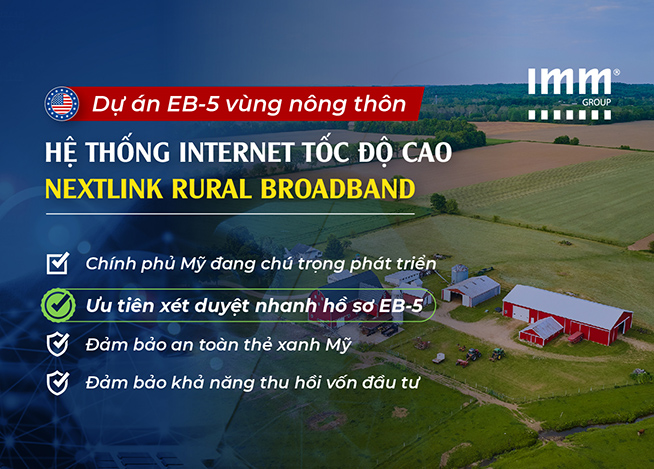
Nextlink Rural Broadband project

Hutchinson Apartments project

Whisky Hotel project
If you are considering U.S. residency by investment, you can contact IMM Group or leave your details below. Our experienced advisors will take you through the requirements in detail and help you review your family’s circumstances against them. We are committed to keeping your personal data confidential and use the information you provide only to advise on your family’s case.
IMM Group
Was this article helpful?
30