Canada Start-up Visa Changes 2024: An Overview of the Key Updates
December 17, 2024 · Start-up Visa · 13 min read
The year 2024 marked a turning point for Canada’s Start-up Visa (SUV) program, bringing a series of notable changes designed to improve efficiency and support the program’s long-term sustainability.
According to Immigration, Refugees and Citizenship Canada (IRCC), immigration drives the country’s economic growth and helps build Canadian society. Against this backdrop, shorter processing times and a more efficient system are key to attracting highly skilled talent. In response, Marc Miller, then Minister of Immigration, Refugees and Citizenship, announced significant changes to Canada’s federal business immigration programs, including the Start-up Visa program. These changes aim not only to reduce wait times but also to modernize the entire process, delivering practical benefits for newcomers and for Canadian society.
This article reviews the key Canada Start-up Visa changes 2024 introduced.

A cap on Start-up Visa permanent residence applications
In late April 2024, IRCC published an official notice on its website announcing changes to the Start-up Visa (SUV) program, which took effect on April 30, 2024:
- A cap on the number of applications: IRCC will process applications for only 10 start-ups per designated organization* per year. In other words, each designated organization can issue only 10 Letters of Support per year.
- Priority processing for start-ups backed by Canadian capital or by a business incubator that is a member of Canada’s Tech Network, covering both applications submitted before April 30, 2024 and new applications.
*Designated organizations assess and support the business ideas or start-up projects of applicants who wish to immigrate to Canada through the SUV program. They fall into three main groups: venture capital funds, angel investor groups, and business incubators. If it agrees to support a start-up, the designated organization issues a Letter of Support (LOS). Every applicant must obtain a Letter of Support from a designated organization before they can apply to IRCC for permanent residence.
The aim of this change is to ensure that designated organizations focus on the quality, rather than the number, of the start-ups they support, while helping to manage and reduce application backlogs and shorten processing times. The policy also signals a preference for high-potential businesses that offer significant economic benefits to Canada.
Updated list of designated organizations
IRCC has updated its list of designated organizations authorized to support start-ups and issue Letters of Support (LOS) to projects that meet the Start-up Visa eligibility requirements. The list also identifies the designated organizations whose Letters of Support qualify for priority processing. These organizations include:
- Venture capital funds
- Angel investor groups
- Business incubators with a commitment to provide capital
- Business incubators that are members of Canada’s Tech Network
Compared with the list published earlier in the year, at least 10 organizations have been removed. IRCC is also not currently designating new organizations.
Open work permits of up to 3 years
Starting October 3, 2024, essential persons on a Start-up Visa team can apply for an open work permit once every member of the team has submitted an application for permanent residence (PR). Under the new rules, the SUV open work permit:
- Is valid for up to 3 years, rather than 1 year as before.
- Allows the applicant to come to Canada early to develop the start-up (accompanying dependent family members may also come early with the applicant).
- Also allows the applicant to take other work to earn additional income, rather than being limited to working for the start-up as before.
However, IRCC has introduced stricter eligibility requirements for the open work permit. Applicants must demonstrate relevant experience, specific business management expertise, and their own role in helping the start-up generate economic benefits for Canada. IRCC will also pay close attention to how the applicant develops the start-up after arriving in Canada on an open work permit. Applicants should be ready to provide a detailed work schedule and specific evidence of these activities if requested. These activities will also be considered when the permanent residence application is assessed and may affect its final outcome.
Therefore, essential persons who choose to come to Canada early on a work permit must be genuinely committed to developing the start-up.
Federal Business admission targets, including the Start-up Visa, fall sharply over the next 3 years
Under the 2025–2027 Immigration Levels Plan, announced in early November, the Government of Canada aims to gradually lower immigration levels to keep population growth sustainable, support the economy, and ease pressure on social services.
To achieve this, Canada will gradually reduce its permanent resident admission targets over the next 3 years, from 500,000 per year (the target set in the 2024–2026 Immigration Levels Plan) to 395,000, 380,000, and 365,000 for 2025 through 2027, respectively. As a result, programs that lead directly to permanent residence, such as the Start-up Visa, will also see a significant reduction in the number of PR admissions each year over the next 3 years.
Specifically, total PR admissions in the Federal Business category (which includes the Start-up Visa and the Self-Employed Persons Program) will fall from 7,000 to 3,000 in 2025, and from 8,000 to 2,000 in 2026 and 2027.

Source: IRCC
Analysts say this policy adjustment marks a fundamental shift in Canada’s immigration strategy, away from volume and toward quality and positive economic impact.
Start-up Visa permanent resident admissions reach a record high
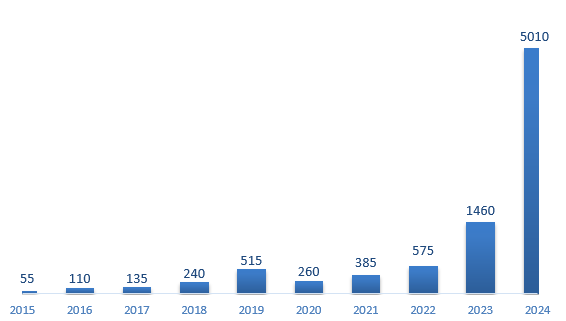
PR admissions under the Start-up Visa by year (Source: IRCC) *2024 figures are through October 31, 2024
Alongside the regulatory changes, the SUV program also saw encouraging results in 2024. Statistics from 2015 to 2024 show that the number of permanent residents (PRs) admitted through the Start-up Visa program grew sharply, from just 55 in 2015 to a record 5,010 in the first 10 months of 2024 alone. The increase is particularly striking: 2024 admissions were already 3.4 times the 1,460 recorded in 2023, making it a breakout year for the Start-up Visa program.
At the time of writing, the program was expected to become more challenging, with tighter eligibility and assessment criteria, yet the Start-up Visa remained a viable route to Canadian immigration for investors with the right background who are committed to following through on their immigration plans.
At the time of writing, IMM Group offered an SUV support package starting from approximately US$166,000, with an experienced Canada-based team guiding investors as they refine and execute their start-up idea, work with a designated organization, and build the start-up in Canada, helping them meet all of the program’s latest requirements and improve the prospects of their application for PR or, where applicable, an open work permit.

If you are interested in Canada’s Start-up Visa program, contact IMM Group or leave your details below. Our experienced advisors will provide detailed guidance and help assess your application’s prospects. We are committed to keeping your personal data confidential and will use the information you provide only to advise on your family’s case.
IMM Group