



Months spent assembling a thick stack of documents. US$800,000 or more placed at real risk — capital that is invested and can genuinely be lost, not a one-off purchase price. Years of patient waiting for an immigrant visa before you can set foot in the United States and begin the journey to a green card.
Is EB-5 worth it, given everything it demands?
In more than two decades as immigration advisors, this is the question the IMM Group team hears almost every week from families.
Our shortest and most candid answer: for the right person and the right family, EB-5 can be an extremely worthwhile decision.
That value does not come from seeing America as a paradise, nor from any belief that a green card will make all of life's problems disappear. EB-5 is truly worthwhile only when it addresses what your family actually needs: broadening your children's opportunities, spreading your assets and business across more than one place so you do not depend entirely on a single market, securing the right to live long-term in a major economy, and giving your whole family a reliable backup plan should the future bring unexpected change.
We want to be candid about this: IMM Group is an investment migration advisory firm. From a business standpoint, we naturally benefit when clients decide to proceed.
However, with more than 21 years in this profession, we have learned that persuading a family that is not a good fit to take this path leads to poor outcomes for everyone involved — the client, the advisor, and the firm's long-term reputation. This article, therefore, is not meant to make the decision for you or to persuade you through emotion. Our goal is to help you assess for yourself whether EB-5 is truly right for your family.
The greatest value is not the green card itself, but the freedom to choose

Many people see EB-5 as a simple transaction: pay a sum of money and receive a green card. That view is technically accurate, but it captures only a fraction of the value.
For a financially established family, the greatest value of EB-5 lies not in the plastic card itself, but in expanding the choices available for the whole family's future.
You can continue to live, run your business, and build wealth in your home country while already having an international pathway in place for your children. You gain the right to place part of your life and your business capital in a major market. And you give your children the freedom to choose where they study, work, and live in the future.
The freedom to choose does not have to be exercised every day to be valuable. In risk management, some protections are put in place not because you expect to need them soon, but because if a crisis ever comes, money alone cannot buy them on the spot.
That is the biggest difference between EB-5 and an ordinary purchase. Your family is not simply moving to a new home; you are preparing future generations to take part, over the long term, in an entirely different economic, educational, and legal system.
What makes the United States worth considering?
The United States has its share of flaws and hard realities that can disappoint newcomers. Yet once you set aside the rose-tinted picture, it still offers fundamental strengths that deserve a family's serious consideration:
The U.S. legal system can be complex, slow, and expensive. But when your rights are violated, there is generally a clear path to file a complaint or bring the matter before an independent court. Your rights depend far less on "who you know." The clarity and protection of the law are an intangible asset of great long-term value.
The value of education lies not only in getting into a top school, but in the number of paths your children can choose. Whether they are suited to research, community college, vocational training, or an entirely new field, the U.S. system offers many starting points and many chances to change direction. Parents are not buying success for their children; they are opening doors so their children can choose freely.
A vast market and a clear division of labor make it easier for people to find work that matches their skills. American culture is open to career changes and to starting over after failure. A setback or two rarely becomes a "life sentence" for a career. This flexibility carries great value: the right to try, and the right to start again.
For business-owning families, having the legal right to live in the United States makes it easier to access capital, technology, and an enormous customer base. A large market always comes with fierce competition, but for capable and experienced people, it is an excellent platform for growing a business.
Keeping all of your property, companies, income, and residence in a single country means placing your entire future in one place. Holding part of your assets in U.S. dollars and gaining the right to live in the United States can give your family greater peace of mind. This is not about turning your back on your home country; in fact, many families continue to live and do business successfully at home after obtaining a U.S. green card. The right way to look at it: you still believe in your home country, but you do not confine your children's entire future to one country.
A green card opens the way to long-term residence and, once you are eligible, a path to U.S. citizenship through naturalization. Green card holders can live in the United States, travel internationally, and enjoy the protection of U.S. law. You do not have to be in the U.S. 365 days a year. However, benefits always come with rules: from the outset, you should understand the residence requirements for maintaining your green card, including how long you can spend outside the United States, as well as the related paperwork.
A two-generation equation: parents make the sacrifices, children reap the rewards
One distinctive feature of immigration is that the people who bear the cost and the people who benefit are often two different generations.
Parents put up the capital, invest the time, arrange their finances, and accept disruption to their lives (including frequent travel between two countries). The children, meanwhile, are the ones who fully benefit from the education, language, friendships, and future career opportunities.
If you only calculate the short-term financial return for the person putting up the money, EB-5 may not be a profitable business proposition. But over a 20- to 30-year horizon, giving your children the right to live, study, and work in two countries is an invaluable long-term investment that parents make for their children.
The value of "freedom to choose" in an uncertain world
No one can know for certain how the world will change over the next 20 years. Economies may be volatile, technology may eliminate many old professions and create new ones, and your children's aspirations may change. In a world with so many variables, flexibility of choice is itself an asset.
Having the legal right to live in a second country does not mean leaving where you live now; it gives your family more room to adapt when circumstances change. Once you have built substantial wealth, the question is no longer "How do we make more money?" but "How do we use our money to bring freedom and security to our family?" Seen from that perspective, EB-5 is not a pure profit-seeking investment, but a way to commit capital in exchange for greater long-term control over your family's future.
Which families are truly a good fit for EB-5?
The EB-5 program is only truly worth considering if your family meets all of the following conditions:
- The EB-5 investment of US$800,000 or more is long-term surplus capital, entirely separate from your business funds and your family's emergency savings.
- Your family will still have enough cash on hand to maintain normal living and business operations after funding the EB-5 investment.
- Your children have a clear desire to study or work in the United States over the long term.
- The decision stems from your family's genuine needs, not from following a trend or from vague fears.
- Family members have discussed in detail what it means to live apart, how parents on both sides of the family will be cared for, and the residence requirements for maintaining the green card.
- The decision-maker is looking at the picture 10 to 20 years ahead, rather than focusing only on when the capital might be returned.
On the other hand, your family should be very cautious if: the EB-5 investment makes up most of your current assets; you would need to borrow money to fund it; you and your spouse are not in agreement; or you are applying simply because others are doing it.
Facing EB-5 risks squarely to make a clear-headed decision
Talking at length about the benefits does not mean ignoring the risks. EB-5 capital is at risk and can be lost; processing times can be long; and project plans or immigration rules can change.
Real life after moving to the United States is not automatically easy either. Living costs, healthcare, and education are very expensive in some states. Someone with a strong social standing at home may well find themselves "starting over" in the United States. Caring for aging parents back home while family members live in different places is another major challenge.
These risks do not mean you should not pursue EB-5; they are a reminder that your family needs to prepare thoroughly. A good plan is not one without risk, but one that helps your family know exactly where the risks lie and have a response ready if things do not go as expected.
Counting the value that does not appear on a balance sheet
If you compare returns alone, EB-5 is certainly not the most profitable investment available. Many other options are easier to execute, more liquid, and have the potential to deliver higher returns.
That is why EB-5 should not be judged as a purely financial investment. Other important forms of value to take into account include:
- The right to live and work legally in a major country.
- More education and career options for your children.
- Building your business and relationships across more than one country.
- A contingency plan you can turn to if conditions where you live change.
- The freedom to let your children choose where they want to live.
- Peace of mind, knowing your family always has more than one path.
10 questions to ask yourself before deciding
Your family should sit down together and answer these 10 practical questions:
- If your investment is tied up for a long time or suffers a loss, will your family's finances still be secure?
- After covering the investment and application costs, will you still have enough cash to run your company and support your life at home?
- Who in your family benefits most from this decision?
- Who will have to bear the most change and sacrifice?
- Do your children truly want to study and build a long-term life in the United States?
- If your family cannot move to the U.S. at the same time, how will you manage your work commitments and the care of parents on both sides of the family?
- Have the legal documents for your business and your family's assets been thoroughly reviewed by an independent professional?
- If the investment generates no return but your family obtains green cards, would that outcome be acceptable to you?
- If you later decide not to move to the U.S., how much would this optionality still be worth to your family?
- Setting aside sales pressure and promotional seminars, does your family genuinely want to pursue this of its own accord?
If you can answer most of these questions clearly, EB-5 is worth exploring further for your family. If many questions remain unanswered, your family may not yet be ready to decide.
Deciding early can pay off financially, but emotion should not drive the decision
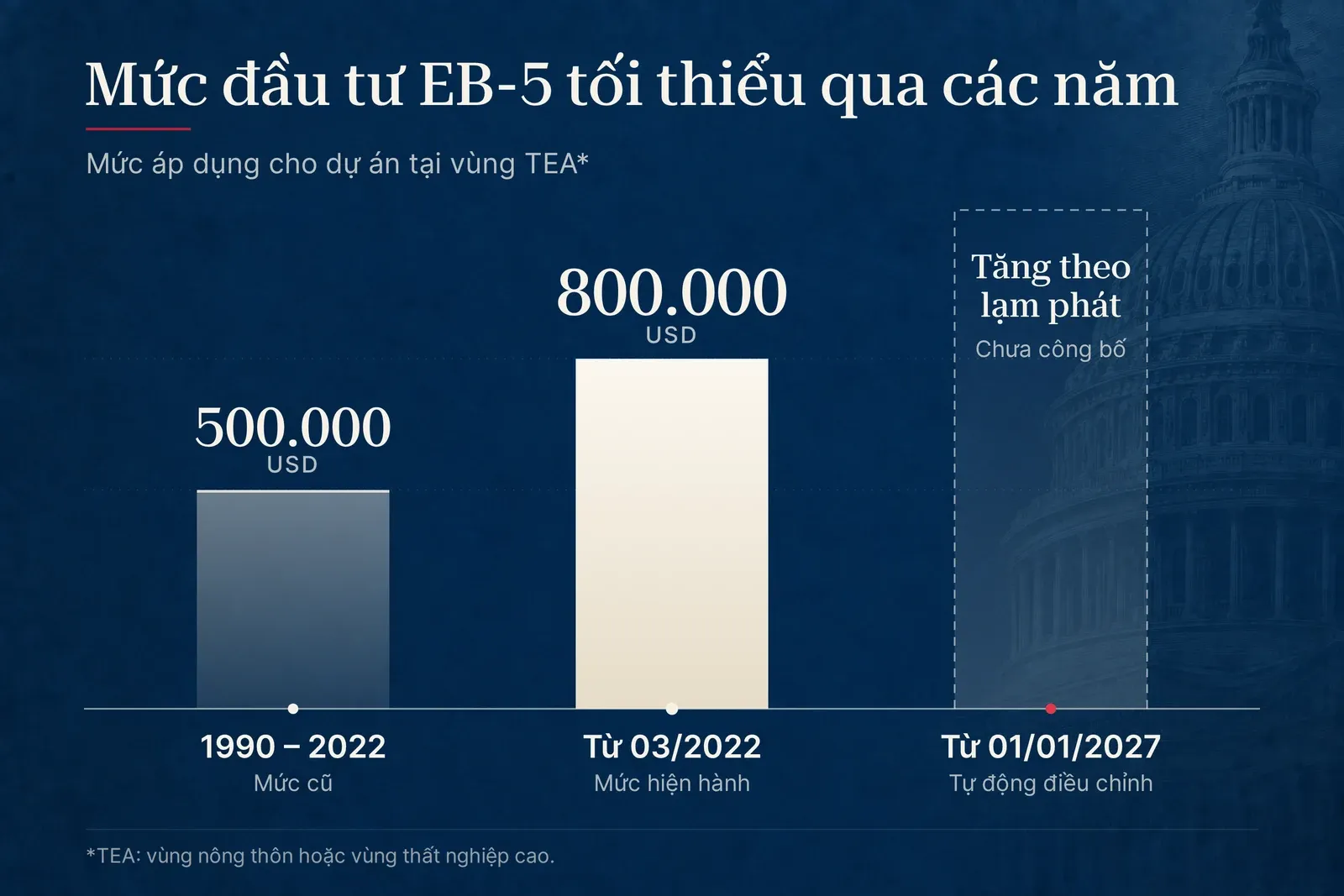
One clear pattern in the history of the EB-5 program is that the minimum investment amount has risen over time (for Targeted Employment Area (TEA) projects, from US$500,000 to US$800,000), and it is expected to rise further.
That is why timing matters so much.
We always advise clients not to commit capital on impulse, out of fear of missing out, or under pressure from aggressive marketing.
That said, if your family has done its research, understands its needs, and is confident the program is the right fit, deciding early can bring substantial financial benefits. Filing sooner may allow you to secure today's lower minimum investment amount and could save you a considerable sum compared with waiting a few years and then having to invest a higher amount.
So, is EB-5 worth it?
For a family with solid finances, capital that can be committed for the long term, clear goals for their children, and a desire to build an international foothold, EB-5 can be well worth it.
Its value reaches far beyond a green card. It lies in your children's future, in greater control over your business, in not concentrating all your risk in one place, and in the freedom for each family member to choose the life they want.
A responsible advisory firm should not try to convince every family that America is the right choice. Its proper role is to help each family understand clearly what they will gain, what they will give up, and how they need to prepare.
That is how IMM Group works. We do not make the decision for you, but we take responsibility for helping you ask the right questions, see every side clearly, and begin only when your family is truly ready.
If your assessment points toward moving, begin with the most thorough preparation possible.
If it points toward staying, continue your life at home with peace of mind. Choosing your home country as the one place you call home remains an entirely sound decision, and one that many families make with pride.
What matters most is not whether you choose the United States or your home country. What matters most is knowing exactly what you are giving up, and what you will gain in return for the next generation.
IMM Group — September 15, 2026
This article reflects the perspective of IMM Group's advisory team and is not a substitute for professional legal or investment advice. EB-5 program rules and investment amounts may change as laws and regulations are updated. Readers should verify this information with qualified professionals before making any decision.


